Saturday, 20 February 2016

CHAPTER 7 - STORING ORGANIZATIONAL INFORMATION DATABASE


RELATIONAL DATABASE FUNDAMENTAL 
  • Information is everywhere in an organization
  • Information stored in database
          Database - maintains information about various type types of object ( inventory),                                 events ( transactions), people ( employees ), and places ( warehouse)
  • Database models include :
          - Hierarchical database model - information is organized into a tree-like structure                    (using the parent/child relationships) in such a way that it cannot have to many relationship 
          - Network database model - a flexible way of representing objects and their relationships
          - Relational database model ( RDM ) - stores information in the form of logically related two-dimensional tables


HIERARCHICAL STRUCTURE


NETWORK STRUCTURE


RELATIONAL STRUCTURE


ENTITIES AND ATTRIBUTE
  • Entity - a person, place, thing, transaction, or event about which information is stored
          - The rows in each table contain the entities
  • Attributes (fields,columns ) - characteristics or properties of an entity class 
          - The columns in each table contain the attributes

KEY AND RELATIONSHIPS
  •  Primary keys and foreign keys identify the various entity classes ( tables ) in the database
           - Primary key - a field ( or group of fields ) that uniquely identifies a given entity in a table
           - Foreign key - a primary key of one table that appear an attribute in another table and acts to provide a logical relationship among the two tables
  • Potential relational database for Coca-Cola


RELATIONAL DATABASE ADVANTAGES

Database advantages from a business perspective include
  • Increased flexibility
  • Increased scalability and performance
  • Reduced information redundancy
  • Increased information integrity ( quality)
  • Increased information security
INCREASED FLEXIBILITY


A well - designed database should :
  • Handle changes quickly and easily
  • Provide users with different views
  • Have only one physical view
  • - Physical view - deals with the physical storage of information on a storage device eg hard disk 
  • Have multiple logical views
  • - Logical view - focuses on how users logically access information
  • Eg: a mail-order buss - 2 people view diff format ( logical views ) but same physical view
INCREASED SCALABILITY  AND PERFORMANCE

A database must scale to meet increased demand, while maintaining  acceptable performance levels.
  • Scalability - refers to how well a system can adapt to increased
  • Performance - measures how quickly a system performance a certain process or transaction 

REDUCED  INFORMATION REDUNDANCY

Database reduce information redundancy

  • Redundancy - the duplication of information or storing the same information in multiple places
Inconsistency is one of the primary problems with redundant information - difficult to decide which is most current and most accurate

INCREASE INFORMATION INTEGRITY  ( QUALITY )

Information integrity - measures the quality of information

Integrity constraint - rules that help ensure the quality of information 
  • Relational integrity constraint - rules that enforces basic and fundamentals information - based constraint
  • Business-critical integrity constraint - rule that enforce business rules vital to an organization's success and often requires more insight and knowledge than relational integrity constraints

INCREASED INFORMATION SECURITY 

Information is an organizational asset and must be protected

Database offer several security feature including : 
  • Password - provides authentication of the user 
  • Access level - determines who has access to the different types of information
  • Access control - determines type of user access, such as read-only access

DATABASE MANAGEMENT SYSTEM

Database management system ( DBMS ) - software through which users and application programs interact with a database


DATA-DRIVEN WEB SITES

Data-driven web site - an interactive web site kept constantly updated and relevant to the needs of its customers through the use of database

7 DATA-DRIVEN WEB SITE BUSINESS ADVANTAGES 

  • Development : allows the Web site owner to make changes any-time--all without having to rely on a developer or knowing HTML programming
  • Content management : A ststic Web site requires a programmer to make updated
  • Future expandability : Having a data-driven web-site enables the site to grow faster than would be possible with a ststic site
  • Minimizing human error : A well -designed, data-driven Web sites will have " error trapping " mechanisms to ensure that required information is filled out correctly and that content is entered and displayed in its correct format
  • Cutting production and updated costs :  a data-driven web site can be updated and "published" by any competent data entry or administrative person .
  • More efficient : with a data-driven solution , the system keeps track of the templates , so users do not have to
  • Improved stability : with data-driven web sites .there is peace of mind , knowing the content is never lost-- even if your programmer is
DATA-DRIVEN BUSINESS INTELLIGENCE
  • BI in a data-driven web sites


INTEGRATING INFORMATION AMONG MULTIPLE DATABASE

Integration - allows separate systems to communicate directly with each other

  • Forward integration - takes information entered into a given system and sends it automatically to all downstream systems and processes
  • Backward integration - takes information entered into a given system and sends it automatically to all upstream systems and process 


Building a central repository specifically for integrated information


without integration , an organization
  •  Spend considerable time entering the same info in multiple system
  • Suffer from the low quality and inconsistency typically embedded in redundant info

hope you all can understand this chapter :)


Monday, 15 February 2016

CHAPTER 6 - VALUING ORGANIZATIONAL INFORMATION


VALUING ORGANIZATIONAL INFORMATION


ORGANIZATIONAL INFORMATION

  • Information is everywhere in an organization
  • Employees must be able to obtain and analyze  the many different levels, formats, and granularities of organizational information to make decisions
  • Successfully collecting, compiling, sorting,and analyzing information can provide tremendous insight into how an organization is performing
  • Level, format, and granularities of organizational information 


THE VALUE OF TRANSACTIONAL AND ANALYTICAL INFORMATION
  • Transactional information verses analytical information
 
THE VALUE OF TIMELY INFORMATION
  • Timeline is an aspect of information that depends on the situation
          - Real - time information -immediate, up-to-date information
          - Real-time system -Provide real-time information in response to query request

THE VALUE OF QUALITY INFORMATION
  • Business decisions are only as good as the quality of the information used to make the decisions
  • You never want to find yourself using technology to help you make a bad decisions faster
THE VALUE OF QUALITY INFORMATION

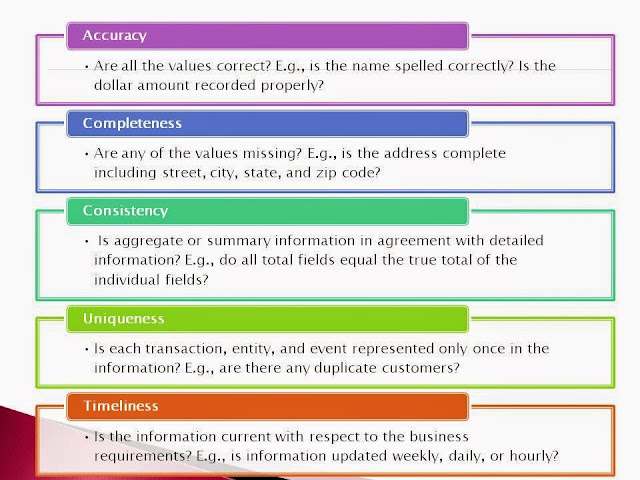
Characteristics of high-quality information include
  • Accuracy
  • Completeness
  • Consistency
  • Uniqueness
  • Timeliness


Low quality information example


UNDERSTANDING THE COSTS OF POOR INFORMATION

The four primary sources of low quality information include :
  1.  Online customers intentionally enter inaccurate information to protect their privacy
  2. Information from different systems have different systems have entry standard and formats
  3. Call center operators enter abbreviated or erroneous information by accident or to save time
  4. Third party and external information contains inconsistencies, inaccuracies and errors
Potential business effects resulting from low quality information include
  • Inability to accurately track customers
  • Difficulty identifying valuable customers
  • Inability to identify selling opportunities
  • Marketing to nonexistent customers
  • Difficult tracking revenue due to inaccurate invoices
  • Inability to build strong customers relationships   
UNDERSTANDING THE BENEFITS OF GOOD INFORMATION
  • High quality information can significantly improve the chances of making a good decisions
  • Good decision can directly impact an organization's bottom line


 Hope you all can understand about this chapter :]

Sunday, 14 February 2016

CHAPTER 5 - ORGANIZATIONAL STRUCTURE THAT SUPPORT STRATEGIC INITIATIVES


LEARNING OUTCOMES :
5.1 Compare the responsibilities of a chief information offer (CIO), chief technology officer (CTO), chief privacy officer (CPO), chief securityrseee officer (CSO), and chief knowledge office (CKO)
5.2 Explain the gap between IT people and business people and the primary reason this gap exists
5.3 Define the relationship between information security and ethics

ORGANIZATIONAL STRUCTURES
  • Organizational employees must work closely together to develop strategic initiatives that create competitive advantages
  • Ethics and security are two fundamentals building blocks that organizations must base their businesses upon

IT ROLES AND RESPONSIBILITIES

  • Information technology is a relatively new functional area, having only been around formally for around 40 years
  • Recent IT -related strategic positions :
  1.  chief information offer (CIO) 
  2. chief technology officer (CTO)
  3. chief privacy officer (CPO)
  4. chief security officer (CSO)
  5. chief knowledge office (CKO)

Chief information offer (CIO) 
Oversees all uses of IT and ensure the strategic alignment of IT with  business goals and objectives.

  • Broad CIO functions include
         - Manager - ensuring the delivery of all IT projects on time and within budget
         - Leader  - ensuring the strategic vision of IT is in line with the strategies vision of the                  organization
         - Communicator - building and maintaining strong executive relationship CIO 

Average CIO compensation by industry

What concerns CIOs the most
  • Chief  Technology Officer ( CTO ) - responsible for ensuring the throughput speed, accuracy, availability, and reliability of IT
  • Chief Security  Officer ( CSO ) - responsible  for ensuring the security of IT systems ( about the hacker/ virus )
  • Chief Privacy Officer - responsible for ensuring the ethical and legal use of information ( advice about the legal : eg. Lawyer )
  • Chief Knowledge Officer ( CKO ) -responsible for collecting , maintaining, and distributing  the organization's knowledge.


IMPROVING COMMUNICATION 

  • Business personal must seek to increase their understanding of IT
  • IT personnel must seek to increase their understanding of the business
  • It is the responsibility of the CIO to ensure effective communication between business personnel and IT personnel 


ORGANIZATIONAL FUNDAMENTALS - ETHICS AND SECURITY 
  • Ethics and security are two fundamentals building blocks that organizations must base their businesses on to be successful
  • In recent years, such event as the 9/11 have shed new light on the meaning of ethics and security


  ETHICS
  • Ethics - The principles and standard that  guide our behavior toward other people 
  • Privacy is a major ethical issue - privacy - the right to be the left alone when you want to be ,to have control over your own personal possessions, and not to be observed without your consent 
  • Issues affected by technology advance 

Intelligent property
Intangible creative work that is embodied in physical form
Copyright
The legal protection afforded an expression of an idea, such as a song, video game and some types of proprietary documents
Fair use doctrine
In certain situations, it is legal to use copyrighted material
Pirated software
The unauthorized use, duplication, distribution or sale of copyrighted software
Counterfeit software
Software that is manufactured to lock like the real thing and sold as such
  •  One of the main ingredients in trust is privacy
  • Primary reasons privacy issues lost trust for e-business
  1.  Loss of personal privacy is atop concern for Americans in the 21st century
  2. Among internet user , 37 percent would be "a lot " more inclined to purchase a product on a web sites that had a privacy policy.
  3. Privacy/security is the number one factor that would convert internet researchers into internet buyers 

SECURITY 
  • Organizational information is intellectual capital - it must be protected
  • information security  - the protection of information from accidental or intentional misuse by persons inside or outside an organization
  • E-business automatically creates tremendous information security risks for organizations


 :) Hope YOU all learning this chapter .. THANK YOU :]


Tuesday, 9 February 2016

CHAPTER 4 - MEASURING THE SUCCESS OF STRATEGIC INITIATIVES


Learning outcomes :
4.1 Compare efficiency IT metric and effectiveness IT metric
4.2 List and describe five common types of efficiency IT metric
4.3 List and describe four types of effectiveness IT metric
4.4 Explain customer metrics and their importance to an organization

MEASURING INFORMATION TECHNOLOGY'S SUCCESS


  • Measure that are tied to business drivers
  • Metric are detailed measures that feed KPIs
  • Performance metrics fall into the nebulous area of business intelligence that is neither technology , nor business centered, but requires input from both IT and business
  • 5M   - man. -material, -money, -meachine

EFFICIENCY IT METRICS  (Doing thing right )

- Measures the performance of the IT system itself including throughput, speed, and availability.


EFFECTIVENESS IT METRICS ( Doing the right things )

- Measure the impact IT has on business processes and activities including customers satisfaction, conversion rates and sell through increases .


BENCHMARKING - BASELINE METRICS

BENCHMARK  - Baseline value the system seeks to attain.

BENCHMARKING - A process of continuously measuring system results, comparing those results to optimal system performance ( benchmark values ), and identifying steps and procedures to improve system performance.

THE INTERRELATIONSHIP OF EFFICIENCY AND EFFECTIVENESS IT METRICS

  • Security is an issues for any organizations offering product or service over the internet
Interrelationship between efficiency and effectiveness


METRICS FOR STRATEGIC INITIATIVE

Metrics for measuring and managing strategies initiative include :
  • Web sites metrics
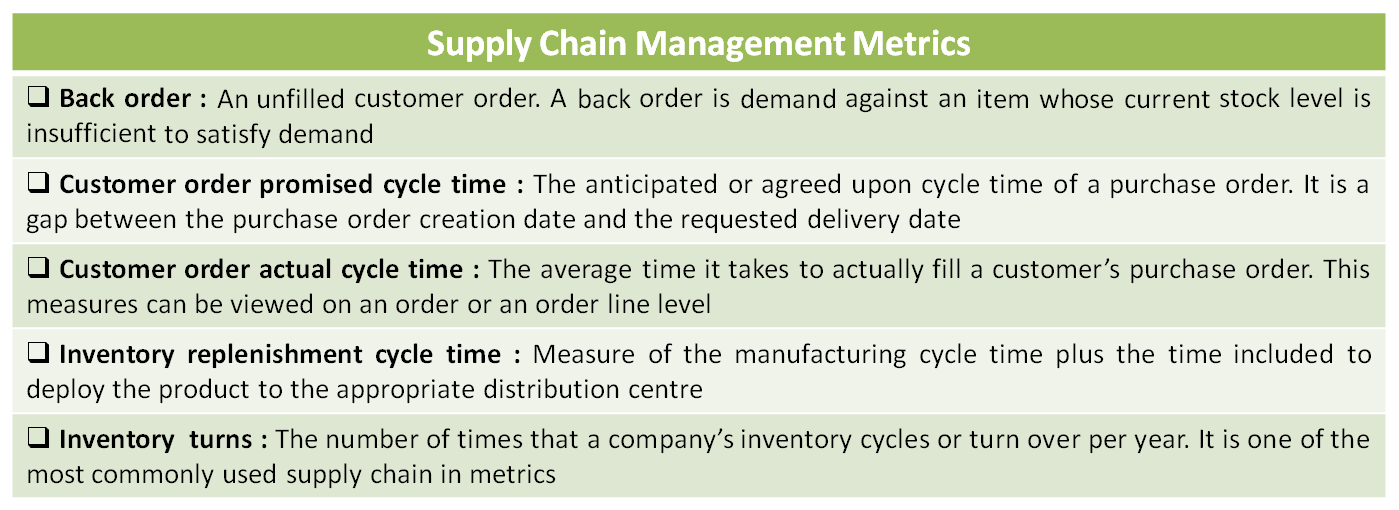
  • Supply chain management (SCM) metric
  • Customers relationship management ( CRM ) metric
  • Business process reengineering ( BPR ) metric
  • Enterprise resources planni g ( ERP )

WEB SITE METRICS


SUPPLY CHAIN MANAGEMENT METRICS


CUSTOMERS RELATIONSHIP MANAGEMENT METRICS

- Customer relationship management metrics measures user satisfaction and interaction and include
  • Sales metrics
  • Service metrics
  • Marketing metric


BPR AND ERP METRICS


The balanced scorecard enables organizations to measure and manage straregic initiatives.


 :) hope you all can understand for this chapter :)


Tuesday, 12 January 2016

CHAPTER 3 - STRATEGIC INITIATIVES FOR IMPLEMENTING COMPETITIVE ADVANTAGES

Learning outcomes
3.1 List and describes the four basic components of supply chain management 
3.2 Explain customer relationship management system and how they can help organizations     understand their customers
3.3 Summarize the importance of enterprise resources planning systems
3.4 Identify how an organizations can use business process reengineering to improve  its business

STRATEGIES INITIATIVES

Organizations can undertake high-profile strategies initiatives including :

  • Supply chain management (SCM)
  • Customer relationship management  (CRM)
  • Business process reengineering  (BPR)
  • Enterprise resources planning (ERP) 
Supply Chain Management (SCM)

- involves the management of information flows between and among stages in a supply chain to maximize total supply chain effectiveness and profitability

FOUR BAIC COMPONENTS

  1. Supply chain strategy -  strategy for managing all resources to meet customer demand
  2. Supply chain partner -  partners throughout the supply chain  that deliver finished product , raw materials and service
  3. Supply chain operations - schedule for production activities
  4. Supply chain logistic - product delivery process
Wel-Mart and Procter & Gamble (P&G) SCM

Effective and efficient SCM system ccan enable an organizations to :

  • Decrease the power of its buyers 
  • Increase its own supplier power 
  • Increase switching costs to reduce the threat of substitute products or service
  • Create entry barriers thereby reducing the threat of new entrance 
  • Increase efficiencies while seeking a competitive advantages through cost leadership  

Effective and efficient SCM system effect on Porter's Five Forces


Customer Relationship Management (CRM)

- involves managing all aspects of a customer's relationship with an organizations to increase customers loyalty and retention and an organization's profitability.

  • not just technology but a strategy ,process and business goal that an organization must embrace on an enterprisewide level
  • can enable an organization to :


          - identify types of customers
          - Design individual customer marketing campaigns
          - Treat each customers as an individuals
          - Understand customer buying behaviors


CRM overview


Business process
-  a standardized set of activities that accomplish a specific task, such as processing a customer's order

Business Process Reengineering (BPR)
- the analysis and redesign of workflow within and between enterprises
  • to make all business processes best-in-class
  • Reengineering the corporation - book written by Micheal Hammer and James Champy  that recommends seven principles for BPR


Finding opportunity using BPR

  • can improve the way it travels the road by moving from foot to horse and then the horse to car
  • BPR looks at taking a different path , such as an airplane which ignore the road completely
Progressive Insurance Mobiles Claims Process
  • types of changes an organizations can achieve along with the magnitudes of changes and the potential business benefit
  • fails to keep up with compertitors
Enterprise Resources Planning (ERP)
-  integrates all departments and functions throughout an organization into a single IT system so that employees can make decisions by viewing enterprisewide information on all business opertantions
- keywords in ERP is "enterprise"


  • ERP system collect data from across an organizations and correlates the data generating an enterprisewide  view


Done ! hope your guys can learnt and understand this chapter .. THANK  YOU :)